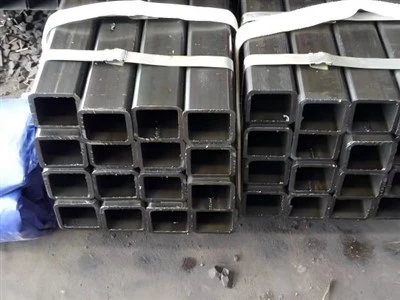
Tianjin Brisk Steel is one of the manufacturers of S355JRH Rectangular Steel Tube in China. Our products are mainly exported to the Middle East, Southeast Asia, Europe, New Zealand, and other regions.If you would like to learn more about our products, feel free to contact us and send your purchase list.


Produce Processing
Distinction by Forming Method
- The mainstream product on the market is the EN10219 cold-formed, high-frequency welded rectangular tube. It is produced via cold roll-forming of steel strip and high-frequency resistance welding; only the weld seam area is heated, and the tube does not undergo overall annealing. Due to cold work hardening at the corners, the local yield strength increases slightly, resulting in superior bending and torsional performance and tighter dimensional tolerances.
- Comparison with EN10210 hot-formed rectangular tubes: EN10219 tubes do not undergo overall heat treatment, offer lower production costs and faster delivery times, and are the optimal choice for standard outdoor steel structures. Hot-formed S355JRH tubes are reserved for applications involving heavy dynamic loads or primary bridge structures.
Processing Suitability and Limitations
- Advantages: Low carbon content allows for gas-shielded arc welding (GMAW), manual welding, and submerged arc welding without preheating, and post-weld heat treatment is generally unnecessary. The tube surfaces are flat and straight, making cutting, drilling, bending, beveling, and threading easy, while minimizing material waste during processing.
- Limitations: Thin-walled tubes (wall thickness < 2mm) are prone to corner collapse during cold forming. Thick-walled, large-dimension rectangular tubes may exhibit high internal residual stress at the weld seam; for mass-produced precision components, adding a stress-relief and leveling process is recommended.
Standard In-House Quality Control
- Each production line includes standard eddy current testing of weld seams, full-length straightening, fixed-length sawing, and end grinding. Tensile tests and thickness > 6mm Charpy impact tests (at +20°C) are performed for each heat/batch, and EN10204 3.1 material certificates are issued; for EU projects, third-party 3.2 certification documentation can be provided.
Forming Process

Surface Treatment
- Inland, dry construction sites: Bare pipe + thin layer of anti-rust oil (lowest cost)
- Outdoor plant areas and bus shelter frameworks: Black anti-rust paint or clear varnish coating
- Coastal and port steel structures: Hot-dip galvanizing (standard zinc coating: 80–85 μm) to resist salt spray corrosion


Core Advantage
- Inherent advantages of rectangular closed sections: torsional resistance far superior to open profiles like I-beams and channel steel; uniform load distribution within the frame; simple alignment during installation and splicing; and high on-site assembly efficiency. The flat outer surfaces facilitate the attachment of cladding panels, the securing of piping and cabling, and the welding of connection components.
- Application scope: Suitable only for structures subjected to static loads or low-frequency dynamic loads at ambient temperatures. For regions with severe or extreme cold (such as Nordic permafrost zones), the material grade must be upgraded to S355J0H or S355J2H, as the ambient-temperature impact performance of S355JRH is insufficient for low-temperature operating conditions.
S355JRH vs S355J0H vs S355J2H
| Grade |
Application Environment |
Markets |
| S355JRH |
Impact resistance at 20°C (ambient), outdoor use in temperate and desert regions |
Infrastructure projects in the Middle East, Turkey, and most of the Balkans |
| S355J0H |
Low-temperature impact resistance at 0°C |
Projects in cold-winter regions of Central Europe |
| S355J2H |
S355J2H High toughness at low temperatures (-20°C) |
Steel structures in Northern Europe and alpine/frigid regions |
FAQ
Q: Will hot galvanizing cause deformation of thin-wall rectangular tubes?
A: We adopt professional preheating & cooling process for thin-wall profiles to minimize deformation. We will remind clients of suitable wall thickness suggestions if ultra-thin size needs galvanizing treatment.
Q: What typical projects apply your S355JRH rectangular tube?
A: Bus station steel frames, workshop main structure, guardrails, equipment supports, outdoor steel frameworks, construction curtain wall keels, widely shipped to Middle East and Southeast European markets.
Q: Is S355JRH rectangular tube easy for welding and secondary machining?
A: Yes. Controlled carbon equivalent brings good weldability for MMA, MIG and submerged arc welding without preheating under regular wall thickness. Cutting, drilling, notching and end bevel processing are all supported in our factory.
Q: Can S355JRH be replaced directly with Chinese Q355B rectangular tube?
A: Not allowed for European, Turkish or Middle East official projects. Q355B is based on GB standard while S355JRH follows EN specification. Chemical composition tolerance and impact test requirements are different. We can provide official EN 10204 3.1 MTC for customs & third-party inspection.


Hot Tags: s355jrh rectangular steel tube, China s355jrh rectangular steel tube manufacturers, suppliers, factory, EN 10210 S355J0H HOLLOW SECTION, high strength hollow section, hollow section analysis, hollow section logistics, hollow section packaging, thick wall hollow section