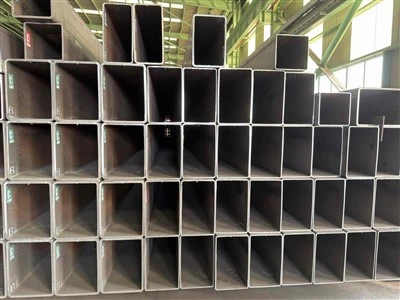
Tianjin Brisk Metalwork Co., Ltd. is one of the leading manufacturers and suppliers of s355 structural hollow section – s355jrh, s355j2h and s355j0h in China. We have world-leading production equipment and strong manufacturing capabilities. Please feel free to buy bulk durable s355 structural hollow section – s355jrh, s355j2h and s355j0h from our factory.


What Do the Three Suffixes Actually Guarantee?
- S355JRH - impact tested at room temperature (roughly +20degC), the minimum guarantee under EN 10219
- S355J0H - impact tested at 0degC
- S355J2H - impact tested at -20degC
All three fall under EN 10219 cold-formed welded structural hollow section. None of them carry the "N" normalizing step - that belongs to a separate product line (S355NH/NLH), which we cover on its own page. If your spec simply says "S355" with no letter, we will always ask which of these three you actually need before quoting, because the price and lead time differ meaningfully between them.
Why Does Wall Thickness Change Which Sub-Grade You Actually Need?
This is the detail most buyers miss, and it is not about your climate - it is about section thickness. Fracture toughness requirements in structural design codes scale with material thickness, not just service temperature: a thin-walled member has a lower risk of brittle fracture at a given temperature than a thick-walled member of the identical grade, because crack propagation behaves differently as thickness increases. In practice, that means a 6mm-wall S355 SHS used outdoors in a mild climate may satisfy code requirements at JRH, while a 20mm-wall S355 SHS in the exact same climate may require J0H or J2H purely because of the extra wall thickness, even though the ambient temperature never changes.
We flag this at quotation stage whenever a buyer sends us a thick-wall order specified as JRH without a thickness-based toughness check - it is a common gap between what gets written on a purchase order and what the actual design code requires for that section size.
Which Sub-Grade Do We Stock as Standard, and Which Needs Extra Lead Time?
S355JRH is our default production run for standard SHS/RHS sizes - it is what comes off the line without any additional testing step, and it is what we can typically ship fastest. S355J0H and S355J2H both require batch-specific Charpy impact testing at the specified sub-zero or 0degC temperature, which means the batch has to be scheduled with our lab and held until results confirm compliance before it ships.
For a common size already in production, moving from JRH to J2H typically adds a small number of extra days to lead time for testing and certification, not for re-manufacturing - the steel itself doesn't change, only the testing and paperwork attached to that batch. For sizes we are not already running, the difference is larger, since the whole batch gets scheduled around the test requirement from the start.
How Do JRH, J0H, and J2H Differ in Price?
The raw material cost is identical across all three - they come from the same chemistry and the same production line. The price difference comes entirely from testing overhead: J0H and J2H require dedicated impact-test coupons pulled and tested per batch, with results recorded on the 3.1 certificate. On a large order this premium is small per tonne; on a small or urgent order, the fixed testing cost is spread over fewer tonnes and the per-tonne premium is more noticeable. We quote all three side by side whenever a buyer is undecided, so the trade-off is visible before the PO is placed.
A Case Where the Wrong Sub-Grade Caused a Real Delay
A fabricator ordered S355JRH in 250 x 250 x 16mm SHS for an outdoor pedestrian bridge frame, based on a general spec sheet that just listed "S355" for the whole structure. When their engineer ran the section through the project's design code check, the 16mm wall thickness combined with the outdoor winter service temperature pushed the toughness requirement past what JRH could guarantee - the material didn't fail any test, it simply had never been tested to the temperature the code required. The batch had to be re-certified as J0H, adding roughly 9 days to the schedule while we pulled new impact coupons and re-ran the Charpy test at 0degC on the same steel, on an order of 14.6 tonnes. The steel itself never needed to change - only the certificate - but the delay was entirely avoidable if the toughness requirement had been checked against wall thickness before the PO was written, not after.
FAQ
Q: Can the same physical batch of steel be re-certified from JRH to J0H or J2H after production?
A: Sometimes, if coupons from that batch are still available and testing confirms it meets the colder-temperature requirement - this avoids re-manufacturing, but it still adds the testing lead time and is not guaranteed to pass. It is faster and more reliable to specify the correct sub-grade before production starts.
Q: Is S355J2H always the "safer" choice regardless of project?
A: Not necessarily from a cost or lead-time standpoint - specifying J2H when JRH satisfies your actual code requirement adds unnecessary testing cost and schedule time without a structural benefit. We can help check which sub-grade your section size and service condition actually calls for.
Q: Do S355J0H and S355J2H cost more per tonne than JRH across all sizes?
A: The testing premium is roughly consistent in absolute terms per batch, so it is proportionally larger on small orders and smaller on large orders - send us your tonnage and we will quote the actual delta.
Q: Can one purchase order mix JRH, J0H, and J2H across different members of the same structure?
A: Yes, and this is common - thinner or interior members often qualify at JRH while thicker or more exposed members need J0H or J2H. We can produce and certify each portion to its own requirement under a single order.


Hot Tags: s355 structural hollow section – s355jrh, s355j2h and s355j0h, China s355 structural hollow section – s355jrh, s355j2h and s355j0h manufacturers, suppliers, factory